
On 21 November 2026 we turned the new-owner guide on mainecoon.sg, our family's cattery, into a two-chapter game. Every word of the guide is still written on the page, so search engines and AI assistants can read it. Here is what we built, the SEO rules we followed, and what a small business could copy.
What is website gamification?
Interactive content is any part of a page that responds to the visitor, such as a calculator, a quiz or a planner. Gamification goes one step further and adds game parts: levels to clear, choices with consequences, and points, stars or badges to collect.
Choices
The visitor decides, and sees what happens next
Progress
Levels, steps or a bar that fills up
Rewards
Stars or points for a good choice
Feedback
A wrong answer explained, not punished
A game is not a ranking factor. Its job is to make the page more useful, and Google asks for content that is "created primarily for people". The words that answer the search still have to be on the page.
The game: "Welcome Home, Kitten!"
The cattery's kitten guide tells new families how to settle a kitten in: one quiet room first, the same food and litter as before, patience when he hides, and slow introductions to the family and any other pets. Until this month, families got most of it as a PDF owner's manual from 2023.
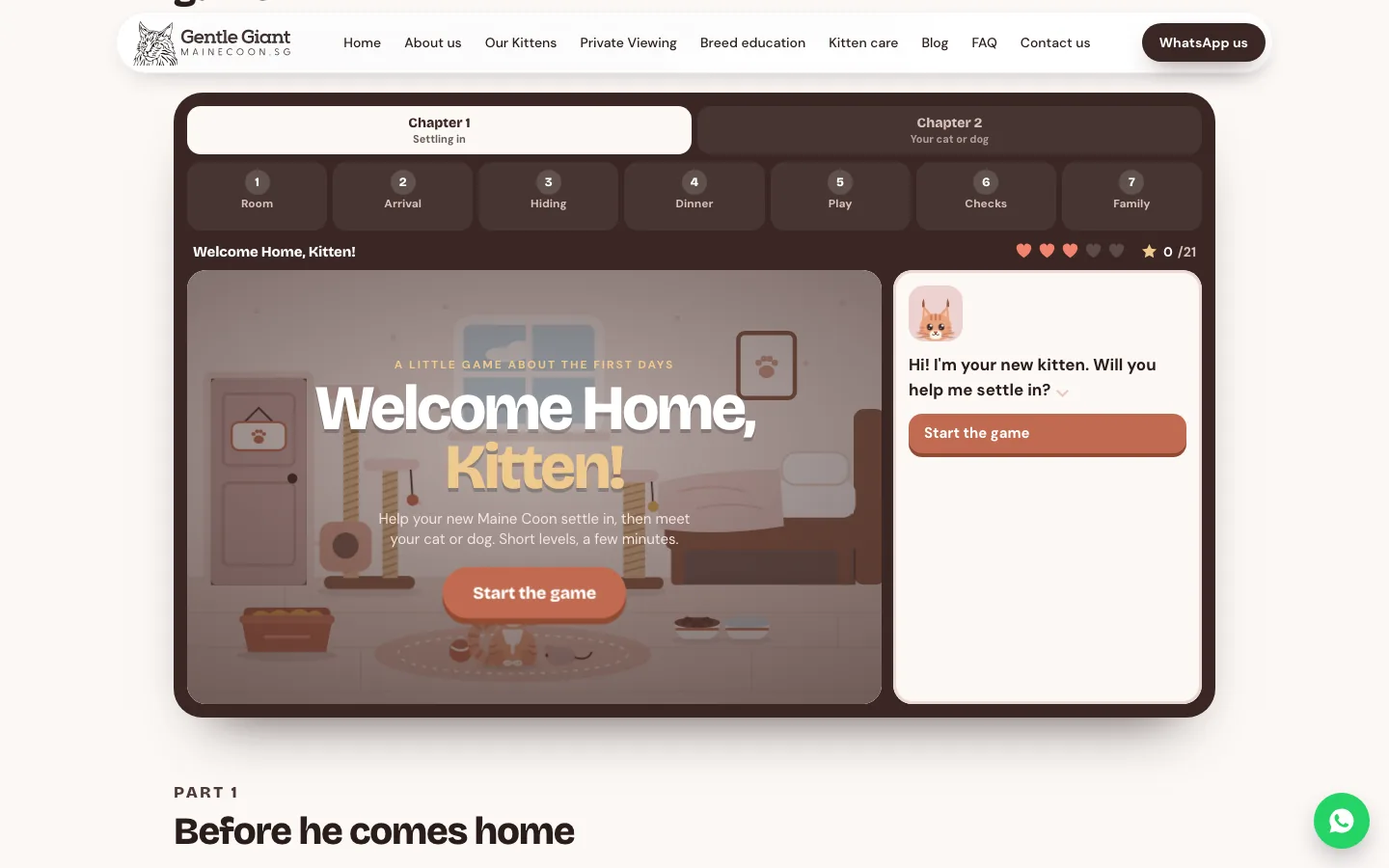
Now the guide opens with a game. A kitten talks you through each level, and you tap what you would do.
- It starts with a question: which pets do you already have at home? A cat, a dog, both or none.
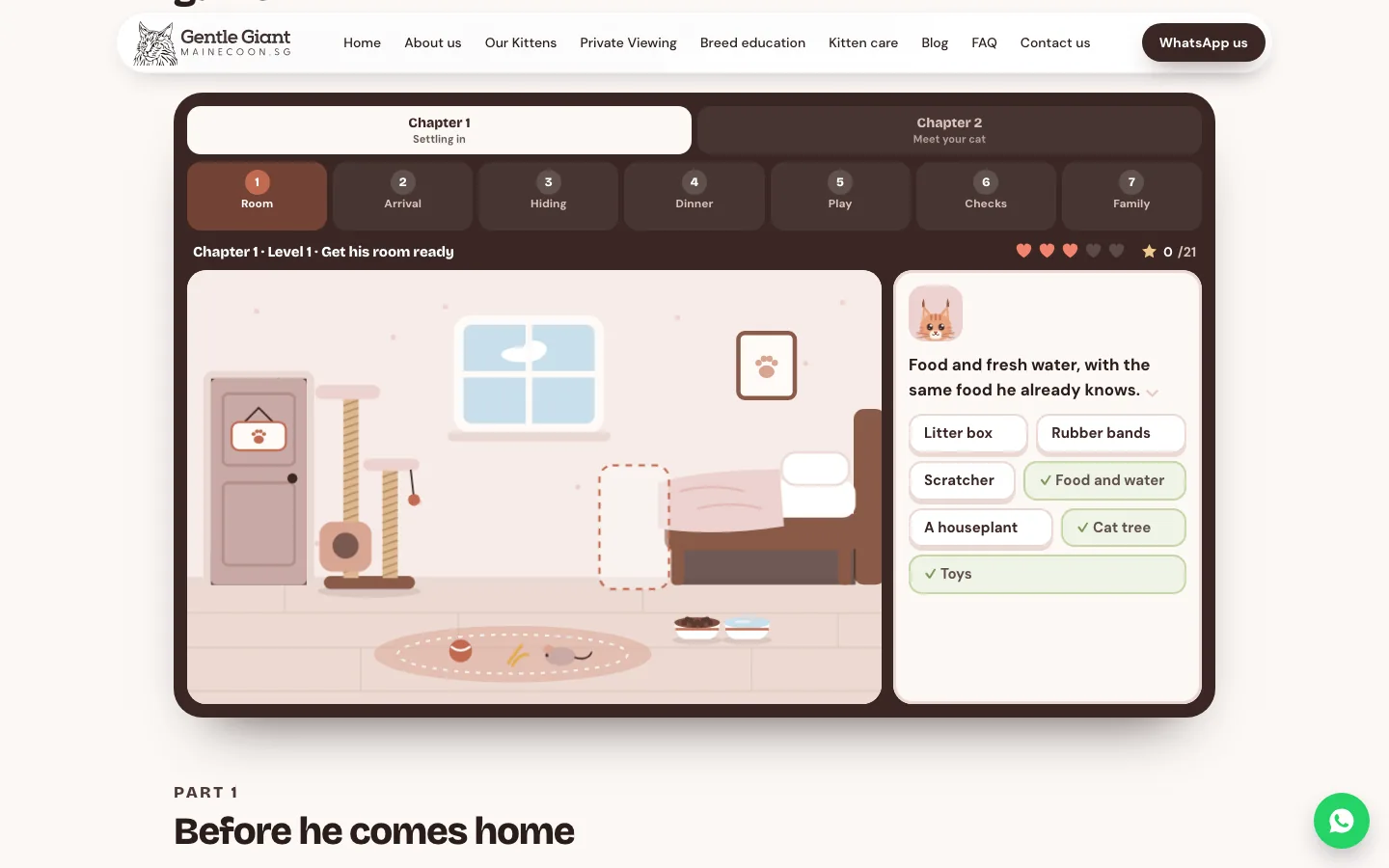
- Chapter 1, Settling in, has seven levels: get his room ready, arrival day, hide and seek, dinner time, play then rest, daily checks, and meeting the family one at a time.
- Chapter 2, Your cat or dog, has five more for families with pets: separate rooms, a swapped blanket for smell, a glass door, short supervised meetings, then friends.
- Comfort hearts and stars show how well the kitten is settling: 21 stars in chapter 1, 36 with chapter 2.
Wrong answers play out instead of just turning red. Reach under the bed to pull him out, and he ducks back in; then the kitten explains why you should sit and wait. Pick the rubber bands for his room, and you learn that string and rubber bands are dangerous if swallowed.
Every line in the game restates advice already written in the cattery's guide or its other care pages. The chapter on other pets follows the cattery's own steps, checked against published advice from Battersea, SF SPCA, PDSA and Petplan, all credited on the page. WebSEO.sg designed and built the game and drew every picture; the cattery wrote the advice.
The SEO rule: the game is extra, the words come first
Here is how we kept the page readable for Google, while the game sits on top.
1. Every word is in the page itself
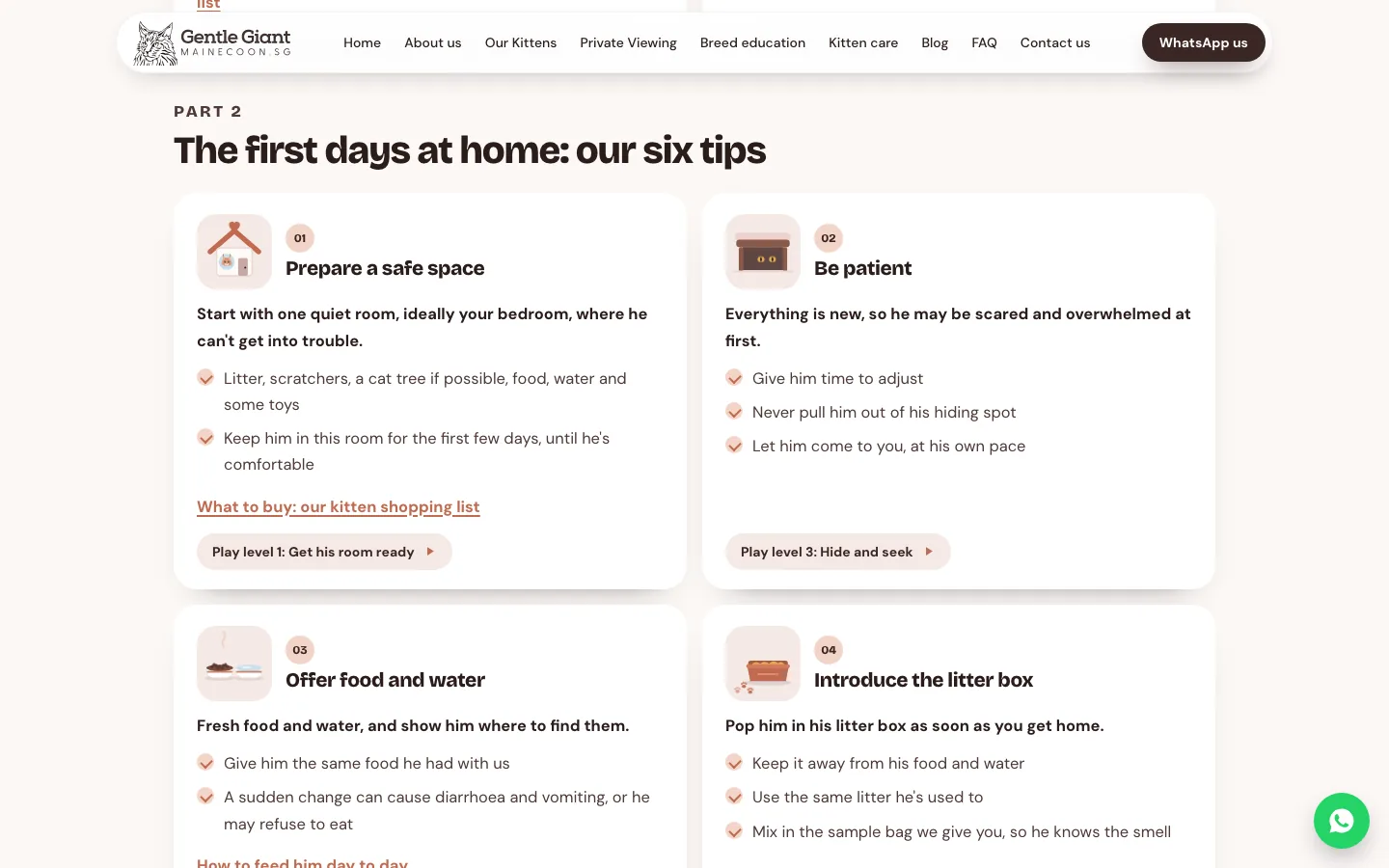
The game needs JavaScript. For anyone browsing without it, the page shows a note instead: "The game needs JavaScript. Everything in it is written out below." And it is: below the game, the whole guide is plain text: before he comes home, the cattery's six tips for the first days, food, the vet, family and visitors, and introducing your cat or dog. Each part has its own heading.
2. JavaScript SEO: Google will not play your game
Google renders JavaScript, but it doesn't play. Its mobile-first indexing guide says Google won't load content that needs a user to swipe, click or type. So anything a game only reveals after a tap may never be indexed. Put the words you want found in the page, not behind the game.
3. AI assistants may not run JavaScript at all
In December 2024, Vercel looked at how AI crawlers fetch pages across its network and found that "none of the major AI crawlers currently render JavaScript". That included OpenAI's, Anthropic's and Perplexity's crawlers. Google's own crawler does render it. If you want ChatGPT or Claude to quote your guide, its words should be in the page's HTML. Google itself says server-side rendering or pre-rendering is "still a great idea", because not all bots can run JavaScript. More on being found by AI assistants in our guide to generative engine optimisation.
4. One address, one clear topic
The game went onto the guide's existing address, /first-days-kitten-home, which Google already knew. The page is now one complete guide for new families, with a title that matches what they search, a heading for every part, eight questions and answers, and links to ten other guides on the site. The cattery shares a short link, mainecoon.sg/guide, on WhatsApp.
5. Load the game only where it is played
The game's code and styles load on that one page, not across the site. The pictures are drawings in code (SVG), not video. In our phone test on slow 4G, the page's main content appeared in 1.4 seconds, with no layout shift and no blocking time. Google's "good" marks are 2.5 seconds or less for the main content and a layout shift of 0.1 or less.
6. Respect people who turn motion off
Some people set their phone to reduce motion. The page checks that setting, prefers-reduced-motion, and stops its animations for them; the game and the guide still work.
7. Keep structured data honest
The page describes itself to search engines as an article with its author, plus its questions and answers. Don't add FAQ markup to win a rich result, though: Google stopped showing FAQ rich results on 7 May 2026. We keep the questions because readers use them.
What we measured, and what we haven't yet
Before the rebuild, Google Search Console showed the old page with 12 clicks and 973 times shown in 16 months, at an average position of about 22. Its biggest topic search was "is maine coon legal in singapore", which nothing on the site answered. That question now comes first in the guide's questions.
7 + 5
levels in two chapters
1.4 s
main content on a phone, slow 4G
0
layout shift
973
times shown in 16 months before the rebuild
What we don't know yet: whether the game brings more visitors, or how far players get. The game sends nothing anywhere, and stars stay in the visitor's own browser. We will compare Search Console numbers four weeks after 21 November 2026 and add them to the mainecoon.sg case study.
Website gamification ideas for a small business
You don't need a game to gamify a page. A few small, honest ideas:
Clinic
A "before your visit" checklist that ticks off as patients read
Home services
Three questions, then a price range
Tuition centre
A five-question level check that suggests a class
Renovation firm
A room-by-room planner that builds a budget
Pet groomer
Pick your dog's coat and size, see the right groom
Any shop
A gift finder that narrows choices in four taps
The home services idea is one of our working samples. For another interactive example, our petagent.sg case study shows a drawn pet journey that moves through the nine steps of an import as you scroll.
Three rules hold for every one of them: the answer is also written on the page, it works on a phone with one thumb, and it helps the customer decide, not just play.
Do you need a custom website for this?
Mostly, yes. A game like this one is custom code: its drawings, levels and choices were written for one page. We compare builders and custom code in website builder or custom website. If you want an interactive page of your own, see our web design service or start with a free SEO check, so you know which page is worth the effort.
Frequently asked questions
Does gamification help SEO?
Not directly. Google ranks pages on how well they answer a search, not on whether they have a game. A game can make a page more useful and memorable, which is what Google asks for, but only if the words are also on the page.
Can Google read content inside a game?
Only what is in the page itself. Google renders JavaScript but won't click, tap, swipe or type, so content that appears only after a player acts may not be indexed. Write the full answer as text on the page as well.
Will a game slow my website down?
It can. Load the game's code only on the page that uses it, use drawings rather than video, and test on a phone. Ours shows its main content in 1.4 seconds on slow 4G.
Do ChatGPT and other AI assistants see interactive content?
Often not. Vercel found in December 2024 that the main AI crawlers, including OpenAI's and Anthropic's, did not run JavaScript. Plain text on the page is what they can read.
What is the difference between interactive content and gamification?
Interactive content responds to the visitor, like a calculator or a quiz. Gamification adds game parts on top, such as levels, rewards and progress, to keep people going to the end.
Sources we used
- mainecoon.sg kitten guide and game — the live page, checked 21 Nov 2026: two chapters, 7 + 5 levels, 21 or 36 stars, the written guide below the game
- Google Search Central: Mobile-first indexing best practices — Google won't load content that needs swiping, clicking or typing (read 21 Nov 2026)
- Google Search Central: Understand JavaScript SEO basics — Google renders JavaScript; server-side or pre-rendering is still recommended because not all bots run it (read 21 Nov 2026)
- Google Search Central: Creating helpful, reliable, people-first content — people-first content (read 21 Nov 2026)
- Google Search Central: Latest updates — the FAQ rich result stopped appearing from 7 May 2026 (read 21 Nov 2026)
- Vercel: The rise of the AI crawler — 17 Dec 2024: none of the major AI crawlers rendered JavaScript in Vercel's data
- web.dev: Web Vitals — good thresholds: main content within 2.5 s, layout shift 0.1 or less (read 21 Nov 2026)
- MDN: prefers-reduced-motion — the setting for less motion (read 21 Nov 2026)
- Our own records: mainecoon.sg in Google Search Console (16 months to 21 Nov 2026) and a phone speed test on slow 4G (21 Nov 2026)