

We are not tax advisers. This guide puts IRAS's own pages into plain English, with dates, so you know what to ask your accountant or software provider. It is current as of November 2026.
What InvoiceNow is
InvoiceNow is Singapore's nationwide e-invoicing network. It runs on Peppol, an international standard, so invoices travel between accounting systems as data instead of PDF files. A business joins with a Peppol ID linked to its UEN.
Under the GST InvoiceNow Requirement, GST-registered businesses use InvoiceNow-ready software to send their invoice data straight to IRAS. Your customers see no difference unless they choose to join the network too.
Who must use it, and when
IRAS is bringing businesses in by phases. Find your row:
- 1 Nov 2025
Newly incorporated companies that apply for voluntary GST registration within 6 months of incorporation
- 1 Apr 2026
Any business that applies for voluntary GST registration on or after this date
- 1 Apr 2028
New compulsory GST registrations, and existing GST-registered businesses with annual supplies up to S$200,000
- 1 Apr 2029
Existing GST-registered businesses with supplies up to S$1 million
- 1 Apr 2030
Existing GST-registered businesses with supplies up to S$4 million
- 1 Apr 2031
Existing GST-registered businesses with supplies above S$4 million
IRAS began notifying businesses registered before 2026 of their dates in mid-2026. If you have not had a notice, IRAS says it will tell you later, with enough time to prepare.
Two groups are left out: overseas entities, and businesses registered for GST only because of the reverse charge.
If you registered for GST voluntarily from 1 November 2025, the rule already applies to you. IRAS says it may refuse the application, or cancel the registration, if you do not comply.
What goes to IRAS
- The invoice data behind your GST return: standard-rated and zero-rated sales and purchases, and exempt supplies.
- These documents: sales invoices, tax invoices, simplified tax invoices, serially numbered receipts, debit notes and credit notes.
- Not needed: deemed supplies, goods exported without a sale, reverse charge transactions, exempt financial services and import permits.
- Cash registers and receipts: sales through a cash register, simplified tax invoices, numbered receipts and petty cash purchases can be sent as totals on a regular basis, not one by one. Your software provider will know how.
- Customer details: each invoice needs the customer's name, UEN and address. For customers who are individuals and not GST-registered, IRAS lets you enter "NA".
Do your customers need InvoiceNow too?
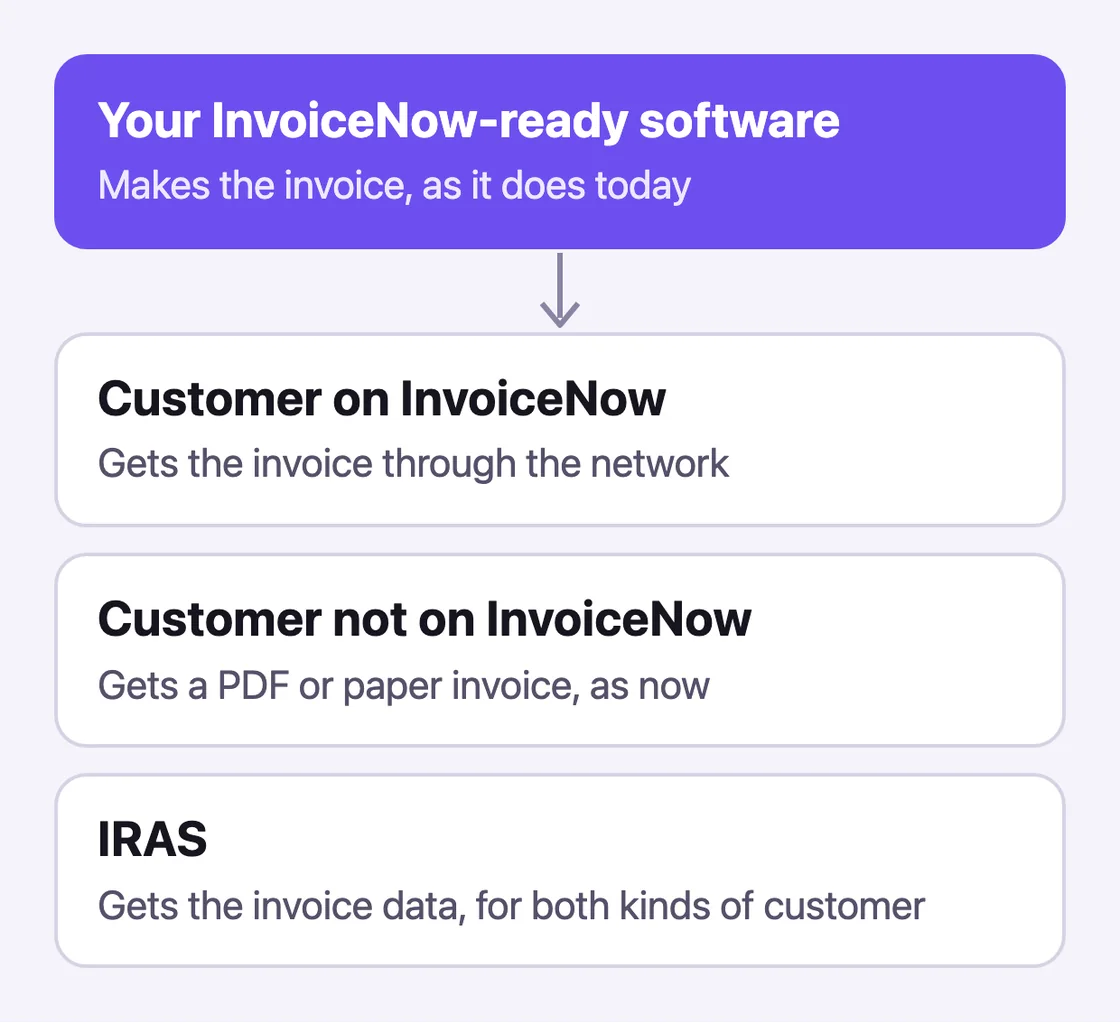
No. If a customer is not on InvoiceNow, you can keep sending them a PDF or paper invoice as you do now. Your software then sends that invoice's data to IRAS separately. IRAS calls these "solution-extracted" invoices.
If a customer is on InvoiceNow, the invoice goes to them through the network, and IRAS gets the data at the same time.
Is InvoiceNow free?
Often, at the start:
S$1,000
Transition Grant, supplies up to S$4 million
S$5,000
Transition Grant, supplies above S$4 million
Mar 2031
free InvoiceNow packages offered until
3 months
the shortest set-up IRAS mentions
- Free packages: IRAS lists InvoiceNow-ready providers that offer free packages for sending invoice data to IRAS, available up to 31 March 2031. You can choose from the current list until 31 March 2027; IRAS says a list for later years will follow.
- Your software may already do it: IRAS says InvoiceNow-ready software makes up "the vast majority of accounting solutions".
- Grants: a GST InvoiceNow Transition Grant of S$1,000 for businesses with annual supplies up to S$4 million, and S$5,000 above that. Larger businesses can also apply for the InvoiceNow Queen Bee Grant of S$25,000.
Before you pay anyone for "InvoiceNow compliance", check IRAS's free list and ask your current software provider.
How to get ready, step by step
- Check your date. Look for IRAS's notice, or work it out from the dates above.
- Check your software. Ask your accounting software provider whether it is InvoiceNow-ready, or choose one from IRAS's list, including the free packages.
- Get your Peppol ID. Your provider registers your business in the Singapore Peppol Directory using your UEN.
- Switch on the GST InvoiceNow submission feature in your software. From then on, your invoice data reaches IRAS through the network.
- Fix your invoice details. Make sure every invoice carries the customer's name, UEN and address, and agree with your provider how cash-register sales are totalled.
- Test before your date. IRAS says onboarding "may take as little as 3 months", and that most businesses finish within a year.
If you run your own billing system instead of off-the-shelf software, it connects through an IMDA-accredited Access Point provider.
Mistakes to avoid
- Waiting for the deadline. Set-up takes months. Start well before your date.
- Thinking your customers must join first. They don't. You can keep sending PDF invoices.
- Missing customer details. Name, UEN and address are required in the invoice data.
- Letting the data drift from your GST return. IRAS expects the two to tally. It accepts genuine differences, such as timing, as long as your records explain them.
- Paying for what is free. Check IRAS's list of free packages before buying a "compliance" service.
What we do, and what we don't
We don't sell InvoiceNow software, and you probably don't need us for it: your accounting software and your accountant can handle it.
Where we help is the work around invoicing. We build systems that make invoices from your bookings or class list, send a PayNow payment link, and send polite reminders that stop when the bill is paid. We run this kind of billing in our own tuition centre, and you can read how in our case studies. We build it so the invoices end up in your accounting software, which then handles InvoiceNow. See our AI automation service for prices.
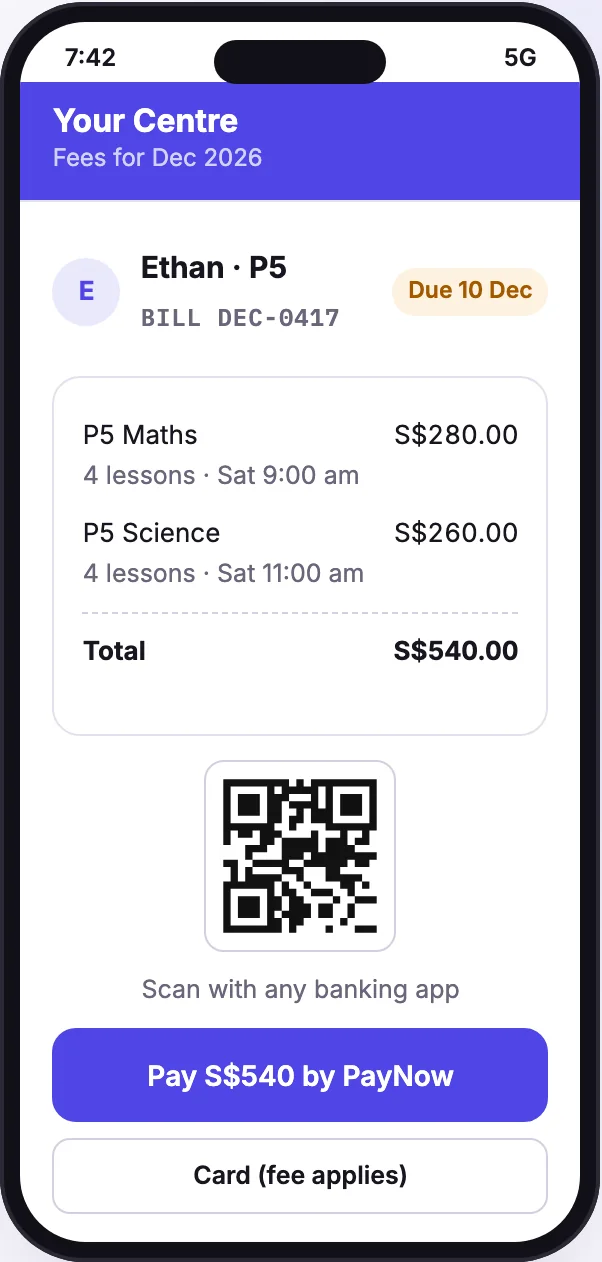
Tap through the whole flow, from the bill to the reminders, in our tuition billing sample.
Grants for software and digital work changed in 2026 too. Our guide to the PSG grant and its replacement, EDGE explains what they pay for.
Frequently asked questions
Is InvoiceNow free?
Often, at the start. IRAS lists providers offering free InvoiceNow packages up to 31 March 2031, and SMEs can get a S$1,000 GST InvoiceNow Transition Grant. Your current accounting software may already be InvoiceNow-ready.
Do I need InvoiceNow if I am not GST-registered?
No. The GST InvoiceNow Requirement applies only to GST-registered businesses. If you are not registered for GST, nothing changes for you.
Do my customers need to be on InvoiceNow?
No. You can keep sending them PDF or paper invoices. Your software sends the invoice data to IRAS separately.
Can my accounting software do InvoiceNow?
Probably. IRAS says InvoiceNow-ready software makes up the vast majority of accounting solutions. Ask your provider, or check IRAS's list of InvoiceNow-ready providers.
When will IRAS tell me my date?
IRAS began notifying businesses registered before 2026 in mid-2026. If you have not heard, IRAS says it will tell you later, with enough time to prepare.
What if I registered for GST voluntarily this year?
If you applied for voluntary GST registration on or after 1 April 2026, or from 1 November 2025 as a company incorporated within the previous 6 months, the rule already applies to you. IRAS says it may refuse the application or cancel the registration if you do not comply.
Sources we used
- IRAS: GST InvoiceNow Requirement — the phased dates, what invoice data is sent, exclusions, how to comply, free packages and grants (read 18 Nov 2026)
- IRAS: Frequently Asked Questions for GST InvoiceNow Requirement (version 26 Oct 2026, PDF) — customers not on InvoiceNow, totals for cash-register sales, customer details, voluntary registrants, reconciliation (read 18 Nov 2026)
- IRAS: Committee of Supply 2026, extension of the GST InvoiceNow Requirement to all GST-registered businesses by April 2031 — the news release behind the 2028 to 2031 dates
- IRAS: e-Tax Guide, Adopting GST InvoiceNow Requirement (PDF) — the full rules, including how to send totals